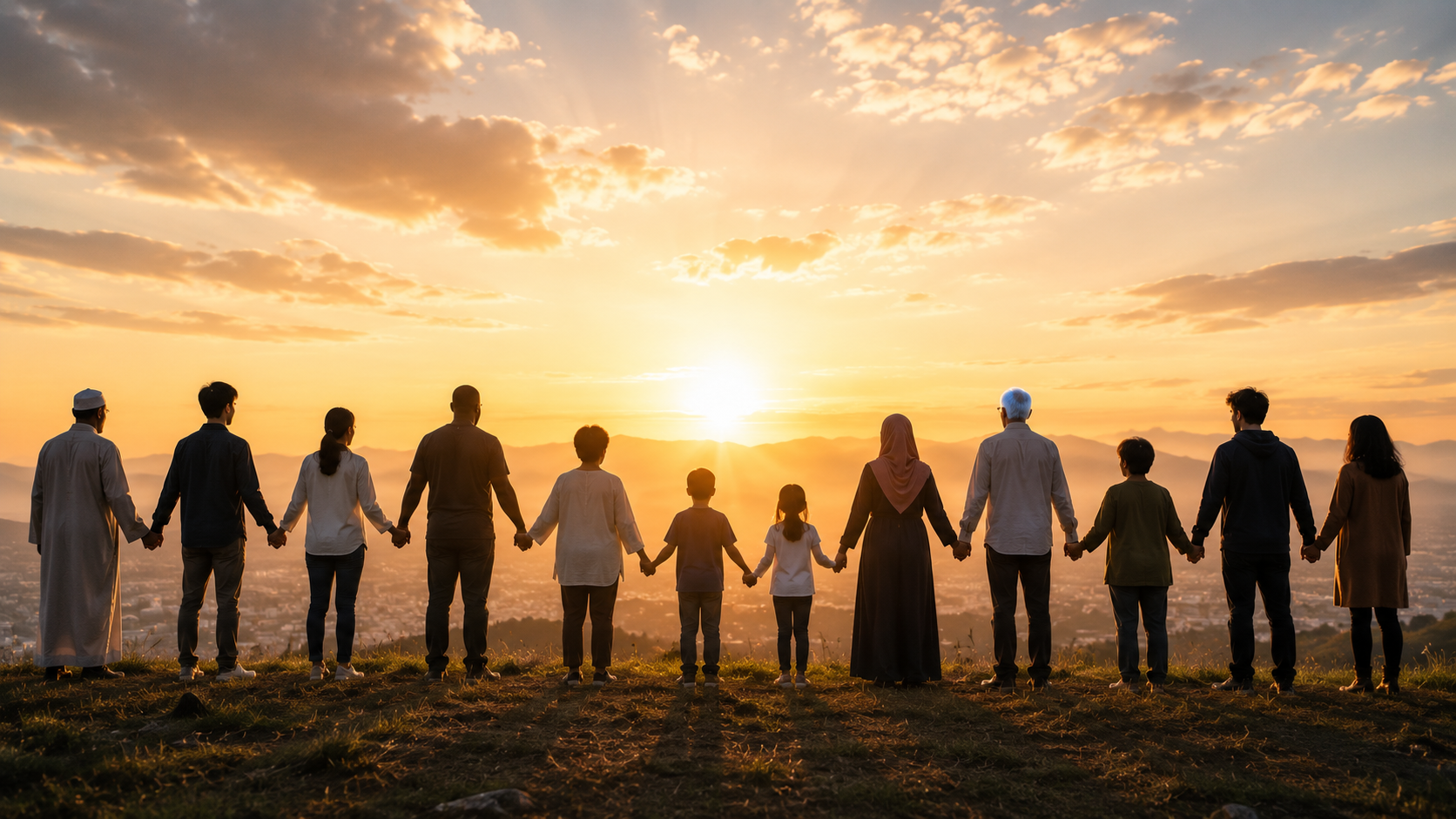
Ask about Islam as a complete way of life rooted in mercy, dignity, and responsibility.
This page is for sincere questions about the real image of Islam: care for children, respect for elders, safety for families, fairness in wealth, learning, justice, mercy, and service to humanity.
Qur'anic foundations
Humanity and human dignity in the Qur'an
These ayat show Islam's foundation of honor, justice, mercy, safety, and shared human origin. English renderings below express the meaning in clear language.
Qur'an 17:70
Every child of Adam has dignity.
We have honored the children of Adam, carried them on land and sea, provided them with good things, and favored them above much of creation.
Human worth is not limited by race, status, wealth, language, or nationality.
Qur'an 49:13
Diversity is for knowing one another.
O humanity, We created you from a male and a female and made you peoples and tribes so that you may know one another. The most noble of you before Allah is the most mindful of Him.
Different communities are not a reason for arrogance. They are a responsibility to recognize, respect, and learn.
Qur'an 5:32
Protecting life is sacred.
Whoever saves one life, it is as though he has saved all of humanity.
A life is not small. Islam teaches that protecting one person carries universal moral weight.
Qur'an 4:135
Justice must be honest.
Stand firmly for justice as witnesses for Allah, even if it is against yourselves, your parents, or your relatives.
Justice is not only for the people we like. It is a duty even when truth is uncomfortable.
Qur'an 60:8
Kindness and fairness are moral duties.
Allah does not forbid you from being kind and just toward those who do not fight you because of religion or drive you from your homes.
Peaceful coexistence is built through fairness, dignity, and sincere good conduct.
Qur'an 95:4
The human being is created with honor.
We created the human being in the best form.
Human dignity begins with creation itself and should be reflected in how people are treated.
Prophetic teachings
Hadith on mercy, care, and safety
These narrations from Sahih al-Bukhari and Sahih Muslim connect belief with how people are treated in daily life.
Sahih al-Bukhari 13; Sahih Muslim 45
Love for others what you love for yourself.
None of you truly believes until he loves for his brother what he loves for himself.
This teaching builds a community where dignity is not theoretical; it becomes daily conduct.
Sahih al-Bukhari 6013; Sahih Muslim 2319
Mercy toward people matters.
Whoever does not show mercy to people will not be shown mercy by Allah.
Mercy is not weakness. It is a sign of spiritual maturity and moral responsibility.
Sahih al-Bukhari 10; Sahih Muslim 40
People should be safe from harm.
The Muslim is the one from whose tongue and hand other Muslims are safe.
Faith should create safety in speech, action, family life, neighborhood life, and society.
What does Islam as a lifestyle mean?
It means faith expressed through daily character: sincerity, prayer, family care, honest work, charity, learning, patience, justice, cleanliness, gratitude, neighborly kindness, and service to people.
Your kids are treated with care and love.
Islam teaches responsibility toward children: protection, mercy, education, emotional care, and the duty to raise them with dignity and good character.
Your elders are respected.
Parents, grandparents, teachers, and elders are not treated as burdens. Their sacrifice, wisdom, and dignity are honored.
You have wealth, but it does not feel like a curse.
Wealth is guided by gratitude, zakat, charity, honesty, fair trade, family responsibility, and the awareness that blessing becomes heavier when it is not shared.
You feel safe and your family feels safe.
A healthy community protects privacy, dignity, trust, women, children, elders, neighbors, and vulnerable people from harm.
How will the ask module work?
Visitors will choose a topic and open a trusted guide. Later, your custom question helpers can support the experience quietly behind clear, respectful front-end cards.